Essay
How Arguments Earn Trust
Inside the hidden infrastructure of authority.

Richard M. Murphy
·

Aerial view of Lahore
Cities are arguments. Their streets and buildings do more than organize physical space. They express ideas about history, power, status, and belonging. The argument is rarely explicit, but it is there to be read.
As a young anthropologist, I spent nearly two years in Lahore, Pakistan, observing how competing ideas about class, religion, and nationhood shaped everyday life. Lahore became intelligible once I could see the social structures connecting people across the city: relationships, reputations, patronage, and language.
The ideas companies advance about their markets, their customers, and the future have a similar hidden structure. A published idea may appear self-contained. The audience sees only the finished artifact—the street frontage, as it were. Its authority comes from the infrastructure behind the artifact: what the organization knows, how it proves and frames the claim, and what it learns once the argument enters the market.
Publishing is the output. Authority infrastructure is what turns expertise into arguments people trust.
Visibility is cheap
The economics of visibility have changed. Once upon a time, institutional gatekeepers decided who could publish and reach an audience. Digital platforms lowered those barriers. Generative AI has lowered them again. Anyone can now produce and publish a plausible article, a polished presentation, or a month of social posts almost instantly and at virtually no cost.
That is an expansion of productive capacity, not necessarily of expertise or insight.
AI can help articulate an argument. It can’t supply the experience that makes the argument worth hearing.
When production becomes abundant, the scarce resources move upstream: original experience, access to evidence, sustained attention, interpretation, editorial judgment, and the willingness to refine an idea over time.
AI can help articulate an argument. It can’t supply the experience that makes the argument worth hearing. It can summarize a conversation. It can't decide which assumptions deserve to be challenged. It can accelerate the journey from idea to publication. It can’t guarantee that a meaningful idea existed in the first place.
Visibility can now be manufactured on demand. Authority cannot. Visibility is a distribution outcome. Authority is an accumulated judgment made by other people. It develops when an audience repeatedly encounters ideas that are original enough to be interesting, credible enough to be trusted, and useful enough to change how they see or act.
By that standard, most organizations aren't building authority. Instead they are amplifying the very noise their audiences are trying to escape: familiar claims, interchangeable insights, and category language that grows louder without becoming more useful. The gap is not that serious audiences ignore thought leadership. The gap is that most thought leadership fails to earn serious attention.
In the 2025 Edelman–LinkedIn B2B Thought Leadership Impact Report, 73 percent of influential stakeholders outside the direct sales conversation said an organization’s thought leadership is one of the best ways to assess the caliber of thinking it is likely to deliver to clients. But in Edelman and LinkedIn’s 2024 research, only 15 percent of decision-makers described the overall quality of thought leadership they encountered as very good or excellent.
There is no shortage of material. What remains scarce is the rigorous, evidence-based thinking that makes authority possible.
Building authority infrastructure
Physical infrastructure is not a single road, bridge, or power line. It is a connected capacity that makes future activities possible. What I call authority infrastructure, similarly, is not one successful article or widely shared idea. It is a durable capacity for producing and circulating useful thinking.
The IBM Institute for Business Value offers one model. Founded in 2002, it surveys and interviews approximately 50,000 executives each year, combining their perspectives with IBM’s industry expertise and research capabilities. Those inputs become reports, benchmarks, frameworks, newsletters, and executive conversations.
The publications are outputs, not the infrastructure itself. The infrastructure connects executive relationships, research methods, subject-matter expertise, editorial judgment, and distribution. Conversations generate questions; questions shape research; findings generate publications; publications prompt new conversations. The system delivers useful, evidence-backed insights to business leaders—and builds IBM’s authority by helping them make sense of consequential business and technology issues.
Visibility can now be manufactured on demand. Authority cannot.
The McKinsey Global Institute (MGI) provides a contrasting model. Where IBM’s research often stays close to the technology and operational choices facing executives, MGI studies structural forces reshaping the global economy and translates them into a fact base for business and policy decision-makers.
Its research agenda spans productivity, prosperity, resource systems, human potential, global flows, and the technologies and markets that will define future competition. Across these themes, MGI’s work is designed to help leaders understand where value is being created, how economic systems are changing, and what choices those shifts require.
That work provides intellectual air cover for McKinsey’s consulting business. MGI need not promote a particular consulting service. By helping leaders distinguish structural change from temporary disruption, it helps define problems that will eventually require action. It places McKinsey inside the conversation before a consulting need has been articulated.
IBM works largely from the executive decision outward; MGI works from the wider world inward. Both connect relationships, evidence, expertise, interpretation, publication, and renewed inquiry.
That’s the difference between publishing content and building authority. A content operation asks, “What should we publish next?” Authority building starts with different questions: “What are we in a position to see? What does our audience need to understand? What can we contribute that is not already circulating?”
The first fills a calendar. The second compounds an advantage.
The Walled City Flywheel
I think of authority infrastructure as a flywheel.
It begins with internal expertise: product knowledge, operating experience, research, and insight available only inside the organization. This is the raw material of authority—what only you can know.
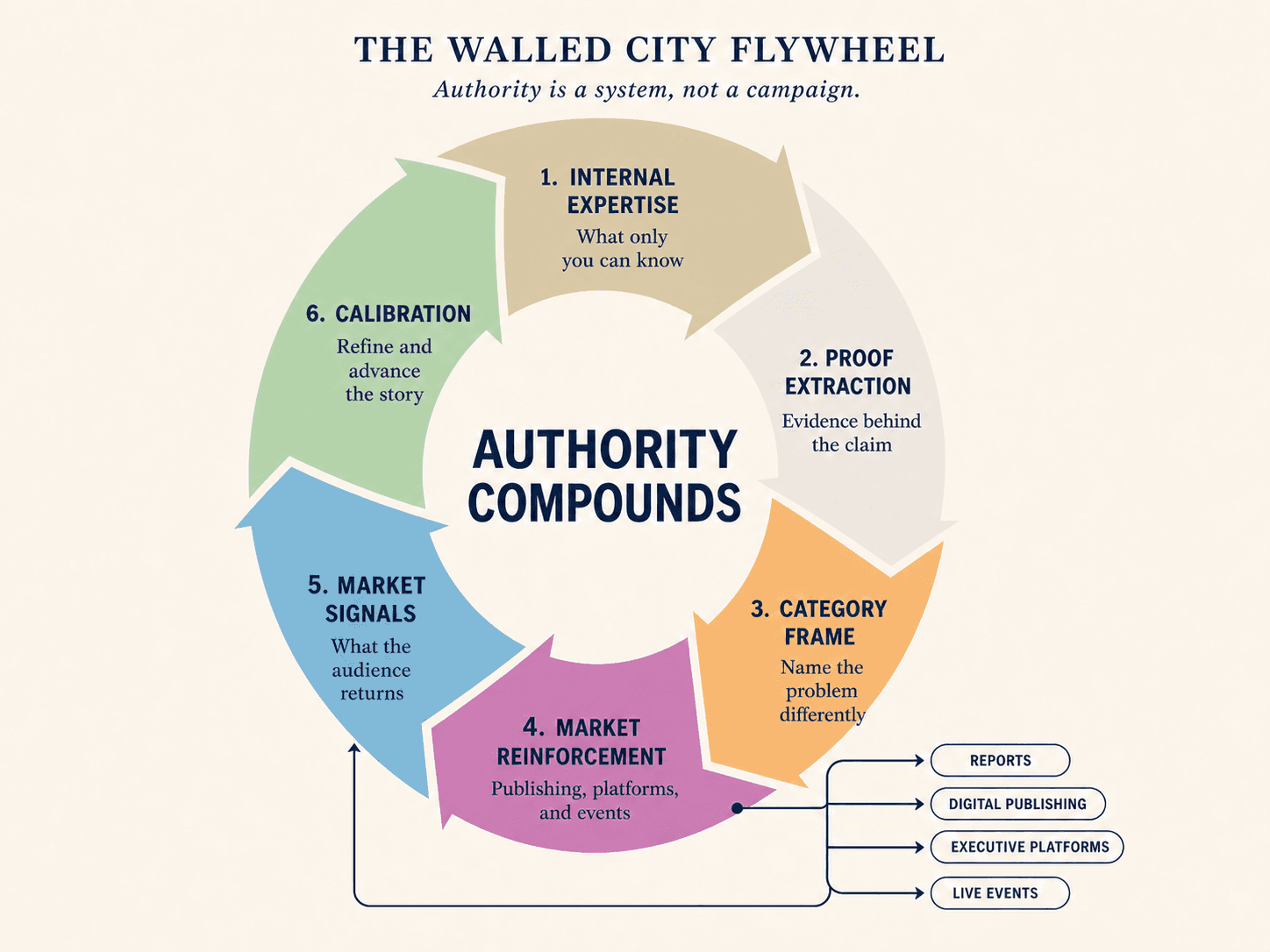
Proof extraction turns that expertise into evidence. Data, case studies, customer experience, and original research give an argument credibility beyond confident assertion.
A category frame establishes what the evidence means. It defines the problem, chooses the right level of abstraction, and helps others understand the issue differently.
Market reinforcement makes the frame portable and repeatable. Publishing, executive platforms, research programs, and live events carry the idea into conversations the organization wants to shape.
Those conversations produce market signals. Audience response, analyst adoption, competitor behavior, and the ways an idea is repeated or challenged reveal what is resonating—and what is not.
Finally, calibration feeds those signals back into the system. The organization refines the frame, strengthens the proof, and advances the story before beginning again.
I have built these flywheels throughout my career. At ServiceNow, for example, my team created the Enterprise AI Maturity Index, an annual study that measured the extent to which enterprises were translating AI hype into business value. Each annual edition built on the questions and findings of the last.
The research then powered ServiceNow’s authority-building across digital publishing, executive platforms, and live events around the world. What began as a research report became a continuing conversation with the market, creating the foundation for the next round of inquiry.
Each turn of the flywheel strengthens the next. Experience creates ideas; ideas attract relationships; relationships provide new experience. Individual publications may disappear from view, but the system becomes more productive over time.
Build upstream
Many organizations invest disproportionately in the visible portion of this system. They fund design, promotion, platform strategy, search optimization, and posting cadence while leaving the upstream intellectual work underdeveloped. The predictable result is polished content that offers little worth remembering.
Does sharing an idea improve your ability to develop the next one?
Building authority requires investment farther upstream. Leaders need contact with customers, employees, practitioners, and ideas outside their immediate field. They need ways to capture what they learn rather than letting it vanish into meeting notes. They need time to compare cases, investigate anomalies, and develop language for patterns that have not yet been named. They need collaborators who will challenge an argument before the market does.
They also need continuity. If every publication is a standalone campaign, its learning is easily lost. If each becomes part of a continuing inquiry, the work compounds. A question from a client conversation can become an essay; the essay can provoke responses; those responses can reshape a framework; the framework can improve future conversations.
The objective is not simply to produce more. It is to create a system in which publishing makes the organization—or the individual—more perceptive. That may be the best test of genuine thought leadership: Does sharing an idea improve your ability to develop the next one?
The central idea of the Walled City Flywheel is that visible forms derive their meaning from hidden systems. The hidden systems that mattered most in Lahore were social: patterns of relationship, reputation, and shared history that connected people across the city.
Corporate authority is built the same way. We see the article, speech, report, or post—not the accumulated experience, questions, conversations, abandoned explanations, and editorial choices behind it. Yet those hidden structures determine whether the finished work earns attention for a moment or trust over time.
The future will bring more content and more visibility. Neither will be scarce. The advantage will belong to those who build something deeper: an infrastructure for noticing what others miss, making sense of it, and returning that insight to the world in a form it can use.
How we use AI
Walled City uses AI as part of its editorial process—the same human-led approach we use to help clients build market authority at scale. We deploy AI as a tool for ideation, research and drafting. Our essays draw on original reporting, proprietary data, experience, sustained revision, and human verification. Walled City remains fully responsible for the ideas, judgment, accuracy, and final work.


